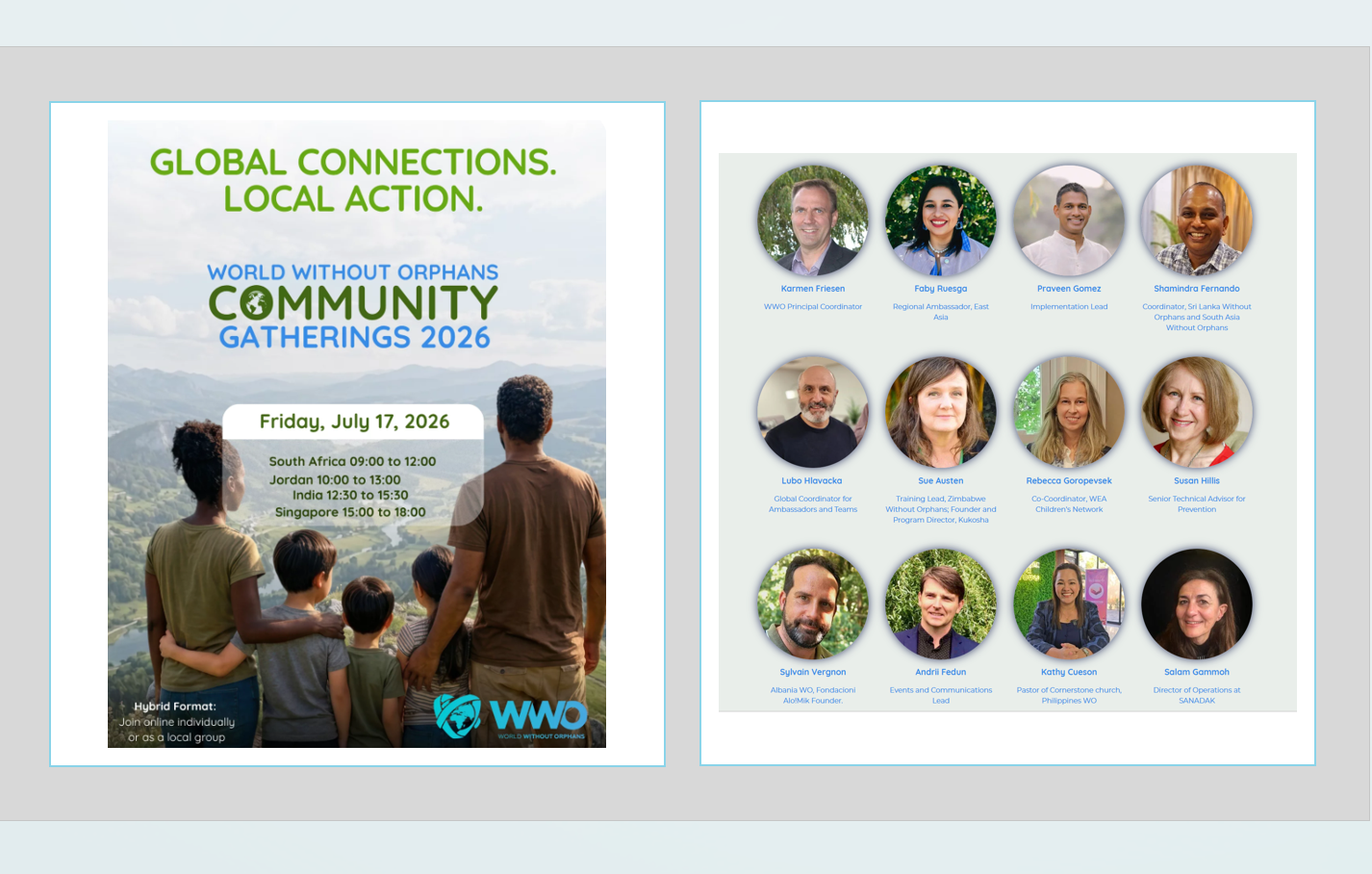
More than 500 people from 58 countries gathered on July 17 for the World Without Orphans (WWO) Community Gathering 2026, united around a vision that organizers said must ultimately be lived out not in global meetings, but in local communities.
Held under the theme “Global Connections, Local Action,” the gathering brought together 256 participants online and 252 people in local in-person groups. Churches, homes, offices and national teams became gathering places for prayer, learning, conversation and reflection on how communities can strengthen families and care for vulnerable children.
Pastor Katherine Cueson from the Philippines welcomed participants as people “united by a shared vision” that every child would grow up in a safe, loving and permanent family and community, know their Heavenly Father and reach their God-given potential.
That vision shaped the gathering’s four main themes: Every Child, Family and Community, Knowing Their Heavenly Father, and God-Given Potential.
Karmen Friesen, principal coordinator for WWO, emphasized that the gathering itself was only one part of a much larger movement.
“This week is just one step in something that’s much bigger than us,” Friesen said, describing the gathering as a picture of the global body of Christ meeting in many places but connected around one vision.
He stressed that no single organization, church, country or program can address the needs of vulnerable children alone.
“What matters most is how you are gathering with others in your community to work together for the sake of children,” he said.
Friesen called participants to develop and strengthen local learning communities where leaders can learn from experts and from one another, act together and return to the table to evaluate what is working. He also encouraged participants to consider who else should be involved, including churches, businesses, government, media and other community leaders.
The gathering began by placing children at the center of the mission.
Children are not an afterthought
Praveen Gomez of Sri Lanka reflected on the biblical teaching that humanity is created in God’s image and emphasized that this includes children.
Children, he said, are not simply future adults waiting for their opportunity to contribute. They can already pray, serve, encourage others and share their faith.
He described children in Nepal who were witnessing to others and young people in Sri Lanka who were leading prayer groups and encouraging their peers.
“These are not small things,” Gomez said. “They are a glimpse of God’s kingdom breaking in through children.”
At the same time, he acknowledged the profound vulnerability experienced by millions of children, including trafficking, addiction, exploitation and being forced to carry adult responsibilities.
He called participants to see children as “image bearers, inheritors and witnesses” and to walk with them into intimacy with God.
Zimbabwean leader Susan Austen then brought the issue down from global statistics to the story of one child.
Austen shared the story of a girl who entered her family after being abandoned by a traumatized teenage mother. Initially, Austen viewed the arrangement as temporary and admitted that she had not fully given her heart to the child.
That changed as the girl’s severe medical needs became apparent. She was eventually diagnosed with hydrocephalus and underwent multiple surgeries.
During one hospitalization, the five-year-old repeatedly asked medical workers whether they loved Jesus. Even while seriously ill, she prayed, worshipped and became a source of ministry to people around her.
Austen recalled a moment when the girl suffered a severe seizure. As she prayed for the child, she realized how deeply attached she had become.
“I need this little girl. I love this little girl,” she remembered praying.
The girl had become more than a child in her care. She had become her daughter.
Now 9 years old, despite developmental and cognitive challenges, the girl is thriving within her family and community. She recently received a school award for being the kindest child in her school.
For Austen, her story demonstrates why children must never be reduced to statistics.
“Every child has a story. Every child has the potential,” she said.
Family is the foundation
The gathering then turned to the second part of the WWO vision: family and community.
Shamindra Fernando, coordinator for Sri Lanka Without Orphans and the South Asia region, emphasized that family is not an accidental arrangement but God’s design for belonging.
Referencing Psalm 68:6, “God sets the lonely in families,” he said that children who grow within secure families develop identity, safety and a sense of self-worth, while communities provide the wider support needed for families to thrive.
Fernando challenged churches to develop local solutions rather than assuming that outside organizations always know what a community needs.
He recalled a conversation among church leaders about alternative care in which one pastor called for a program and funding, while another responded that local leaders understood their own challenges and could develop their own solutions.
Supporting a vulnerable family may sometimes involve simple practical actions, he explained — providing a meal for a single mother, helping with transportation or assisting with childcare.
“No family should walk this alone, and neither should we,” Fernando said.
Faby Ruesga, a Mexican missionary living in Hong Kong, illustrated that principle through her experience as a foster parent.
Her challenge to participants was to ask how willing they are to be “inconvenienced by the gospel.”
Ruesga described fostering an abandoned baby girl who initially disrupted her busy schedule but ultimately changed the direction of her ministry. After the baby was adopted, Ruesga began advocating for changes in legislation and practices surrounding vulnerable children.
A second foster placement, a seriously ill baby boy, deepened that calling.
Her involvement eventually opened doors for Ruesga to advocate for children’s rights at the United Nations in New York.
What began with one child, she said, became an opportunity to influence communities, churches, governments and international institutions.
“By serving the least, God has opened the way to serve the top,” she said.
From family to the Father’s heart
The third part of the WWO vision focused on helping children know their Heavenly Father.
Cueson reflected on Psalm 68:5, which describes God as “a father to the fatherless,” and argued that meeting a child’s physical needs is essential but does not address every question carried by children who have experienced abandonment or rejection.
Children also ask: Who loves me? Do I belong? Am I wanted?
Knowing God, she said, gives children a deeper identity that is not defined by what happened to them.
She also emphasized the role of Christian caregivers in reflecting God’s character. Patience, faithfulness, forgiveness and consistency can help children experience something of the Father’s heart through the people who care for them.
A story from Albania illustrated the long and sometimes complicated nature of that journey.
Sylvain Vergnon, founder and director of Fondacioni Alo!Mik, described a girl whom he and his wife, Ruth, met as a child in an Albanian orphanage. Although she eventually heard the Gospel and was baptized, deep questions about abandonment, grief, guilt and rejection remained unresolved.
When she left institutional care at 18, she faced an uncertain future with little money, no stable home and significant responsibility for her mother, who had serious mental health challenges.
Over time, however, the young woman developed resilience and built a stable life. Vergnon said that through relationships marked by consistent presence and unconditional love, she eventually experienced a deeper reconciliation with God and came to embrace the Father’s heart.
Today, the woman is married, works as a social worker and reaches out to vulnerable children. She also cared for her estranged father after he suffered a stroke, remaining with him in the hospital and helping him overcome alcohol dependency.
For Vergnon, her journey illustrates the importance of both biblical truth and the relational journey of the heart.
God-given potential begins with belonging
The final part of the WWO vision — reaching God-given potential — was addressed by Rebecca Goropevsek of the World Evangelical Alliance Children’s Network.
She cautioned against defining potential primarily through achievement, education, career or ministry.
Before achievement comes identity, she said, and identity is formed through belonging.
Goropevsek pointed to the order of the WWO vision itself: children first grow in a loving and caring family and community, then come to know their Heavenly Father, and from that foundation are able to reach their God-given potential.
She connected this principle with the WEA’s family-based care statement, released June 1, which calls Christians to recognize the importance of family-based care and strengthen families so that children can grow within safe and loving environments.
She also highlighted findings from a recent Barna study conducted with Faith to Action. Ninety percent of U.S. Christians surveyed said children thrive best in family environments, while 72% recognized poverty rather than the death of parents as the primary reason children enter orphanages.
Yet, she noted, financial giving has not necessarily followed this change in understanding. U.S. Christians give an estimated $4.5 billion annually to orphanages, according to the study.
Goropevsek encouraged churches, organizations and donors to consider how resources can instead support family preservation, reunification, kinship care, foster care and adoption.
Susan Hillis, a researcher and senior technical adviser for prevention, reinforced the importance of helping children become safe, loved and able to flourish.
She challenged participants to consider whether they themselves are pursuing their God-given potential, because children often learn more from what adults demonstrate than what they teach.
Hillis, who has adopted eight children at older ages, described looking back on decades of family life as a journey of walking children “from darkness into His radiant light.”
From gathering to action
The gathering concluded with a challenge not to let the global event become an isolated moment.
Friesen urged participants to take concrete steps in their own communities: start conversations, build learning communities, meet regularly, invite missing voices to the table and look for opportunities to act together.
WWO leaders also highlighted several upcoming opportunities for continued collaboration, including Orphan Sunday on November 8, 2026, regional gatherings and a planned Global Forum in early 2028.
Andrii Fedun of Ukraine described Orphan Sunday as a practical way for churches to move from awareness to prayer, action and collaboration. He recalled how Ukraine’s early prayer initiative grew from more than 6,000 participating churches in its first year to more than 18,000 in subsequent years.
The goal, he said, is not simply to organize an event but to begin something that continues beyond one Sunday.
As the gathering closed in prayer, participants were reminded that the global connection ultimately exists to strengthen local action — so that more children can grow up in safe and loving families, know their Heavenly Father and reach the potential God has given them.
The online gathering ended, but the movement’s work continues in homes, churches, communities and national teams around the world.
The challenge from WWO was simple: start with the next faithful step.